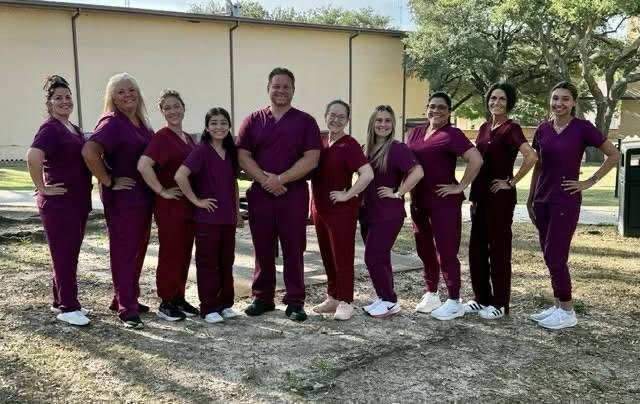
The adult learner's path is not always linear, but with Trinity Valley Community College's Adult and Continuing Education (ACE) program, there is a place to start for everyone.
“Adult and Continuing Education provides learning opportunities for adults of all ages and areas of interest,” said ACE Director Chris Hicks. “Classes are designed to develop job related skills, prepare adults for the workforce, and provide opportunities for personal enrichment and professional development.”
There are many moving parts below the surface of ACE’s mission, however.
“We are supported through partnerships, coalitions, and other resources that foster informed communities through engagement, encouragement, and empowerment,” Hicks explained.
These partnerships and coalition members work with ACE to provide services such as General Education Development (GED), English as a Second Language (ESL), citizenship, and more.
“When you’re working with a disenfranchised group, and that is often the group we work with, they can be victimized over and over again,” said Hicks. The ACE team, along with their partnerships, work to ensure these groups are receiving the legitimate tools and support required for whatever services they’re in need of.
Though there is no federal financial aid funding available for ACE students, there are many other non-traditional financial resources available.
“Part of what we’re responsible for is making sure the consumer knows what those resources are. It’s their choice at the end of the day, but they should be able to access all kinds of financial opportunities,” Hicks expressed, “there is always money out there.”
ACE works closely with workforce development areas to connect eligible students with funding through the Workforce Innovation and Opportunity Act (WIOA). For those who qualify, funding can cover tuition, fees, testing and other associated costs. Community Services Inc., out of Corsicana, can provide funding for eligible adult learners as well.
Fast-track workforce programs offered through ACE include Phlebotomy, Certified Nurse Aide, Medication Administration and EKG, which was added this past summer.
“What we want is for someone to have a little bit of success. Once they have that success, whether it’s obtaining their citizenship, their GED, or whatever their goal is, they’ve removed that barrier,” said Hicks.
For adult learners, removing that first barrier can open the door to opportunities ranging from workforce training to professional development and personal enrichment. Through ACE, those opportunities are designed to meet learners wherever they are, and wherever they hope to go next. But preparing adults for the workforce is only one piece of ACE’s reach.
ACE also offers an online academy, Ed2Go, with courses covering a variety of topics, including fundraising, grant writing, job searching and more. The online format allows learners to access educational opportunities on their own schedules.
“We had a small town on the other side of Cedar Creek Lake where the mayor wore three hats, and he had an assistant who needed to know Excel,” said Hicks. “Ed2Go has fantastic Excel classes. She was comfortable with that, and we were able to meet that small city’s need.”
That flexibility extends beyond workforce training and professional development. ACE also provides opportunities for personal enrichment and community learning, with courses developed in response to the interests and needs of the communities TVCC serves.
New course ideas can even begin with a suggestion from a community member or TVCC employee.
With about five course proposals currently in development, ACE continues to explore new ways to turn those ideas into learning opportunities.
“I’ll give you an example. Donna Bennett, one of our own, came to me years ago when I first started in this role. She said, ‘Do you think anybody would be interested? This is what the concept is.’ That course proposal turned into a class,” Hicks explained.
Developing new courses isn’t the only way ACE responds to community interests. In some cases, existing TVCC credit courses can be mirrored as Continuing Education sections, giving adult learners another way to access educational opportunities.
Mirrored courses require approval from the credit course instructor and are dependent on seat availability, ensuring Continuing Education students do not take the place of students pursuing the course for credit.
For example, over the summer, two men contacted ACE with an interest in TVCC’s animal reproduction course.
“We said we have a course that we can mirror, but we have to get the instructor’s permission,” Hicks said. “It worked out. Those gentlemen were able to enroll in the fall animal reproduction course, and they’re happy as clams.”
Mirrored courses can also provide opportunities for personal enrichment, particularly for participants in TVCC’s Senior Gold Card program. The program offers eligible seniors a variety of benefits, including a 50 percent discount on Continuing Education tuition.
Another great example, last spring, two Senior Gold Card members joined Cardinal Singers through a mirrored course alongside credit students. They were able to travel with the group to Carnegie Hall and receive the same benefits as students enrolled for credit.
“We try really hard to provide that learning opportunity in whatever venue we may have available, whether it’s a standalone Continuing Ed class that we develop, a credit class that we can mirror, or a nonprofit working with us to offer an educational opportunity,” said Hicks.
With such a wide range of opportunities available, the ACE team also works to help adult learners determine which path is right for them. Whether someone knows exactly what they’re looking for or simply knows they’re ready to take the next step, the department aims to meet them where they are.
Program Specialist April Brown serves as ACE’s in-house advisor, helping learners identify opportunities that align with their interests and goals.
“When we get those calls, whatever their interest may be, our job is to find what they’re looking for,” Hicks said.
For adult learners, taking that next step can sometimes be intimidating. Whether they are returning to education after years away, pursuing a new career, or simply looking to learn something new, Hicks understands that the path may look different for everyone.
“The adult learner’s trajectory is not linear,” Hicks said, “it takes different paths.”
For those who may be unsure of where to begin, ACE strives to be a starting point, even when the answer ultimately leads somewhere else within TVCC or the community.
“We want to be that touchstone,” Hicks said, “even if something may not be in our wheelhouse, we will make sure you are connected with that person, department or piece of information that is critical to your next step. We don’t abandon them.”
For ACE, the path may look different for every learner, but the goal remains the same: helping each person find their next step.
For more information about ACE, visit https://www.tvcc.edu/academics/adult-continuing-education/index.html. To contact the ACE department, call 903-675-6212, or email conted@tvcc.edu.